At Bridgewater, we follow the Early Years Foundation Stage (EYFS) framework which identifies the Seven Areas of Learning as the foundation of our approach to creating a rich and engaging learning environment. Here, we recognise and value each child as an individual, tailoring opportunities to support their growth in every area of learning.
By nurturing positive interactions with adults and peers, and creating inspiring, calming and enabling environments both inside and outside the classroom, we support and enhance each child’s development. The characteristics of effective learning – playing and exploring, active engagement and critical thinking – help children build on existing knowledge, make connections, develop curiosity and acquire deeper understanding.
The Seven Areas of Learning are divided into two groups: Prime and Specific areas.
The Seven Areas of Learning – Prime areas
The Prime areas are fundamental in igniting children’s curiosity, enthusiasm for learning, and capacity to learn, form relationships and thrive.
1. Communication and Language
This area is divided into two strands: ‘Listening, Attention and Understanding’, and ‘Speaking’.
Children learn to sit quietly, listen carefully, ask and respond to questions, and engage in back-and-forth discussions. We encourage confidence in speaking and listening through a vast range of opportunities. Staff support children in using proper pronunciation, the correct tense, and in following instructions effectively.
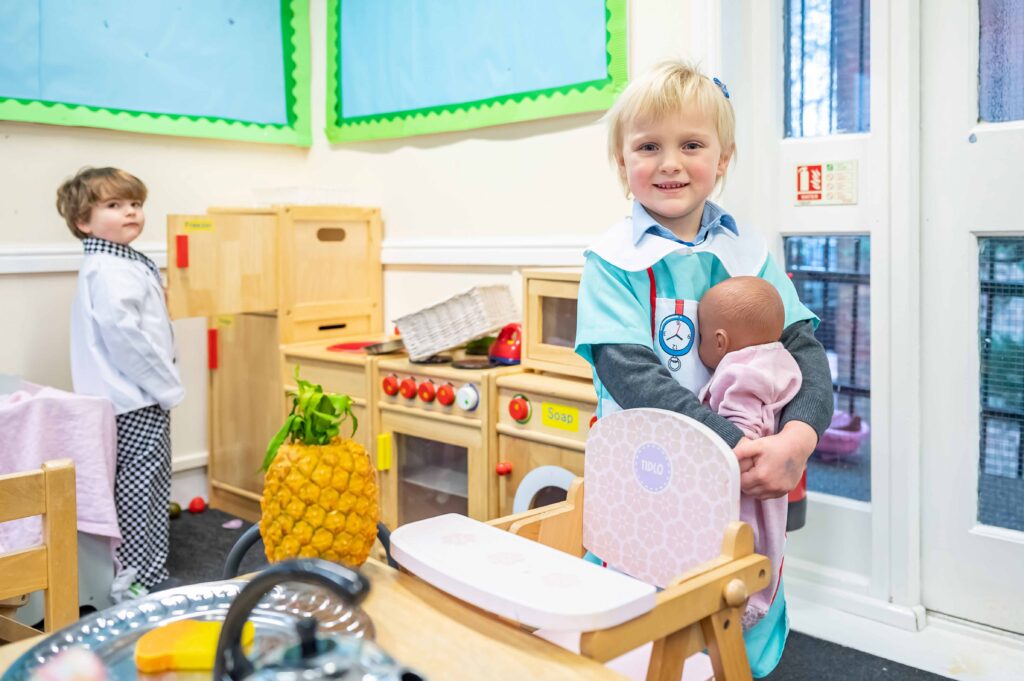
2. Physical Development
This area encompasses ‘Gross Motor Skills’ and ‘Fine Motor Skills’.
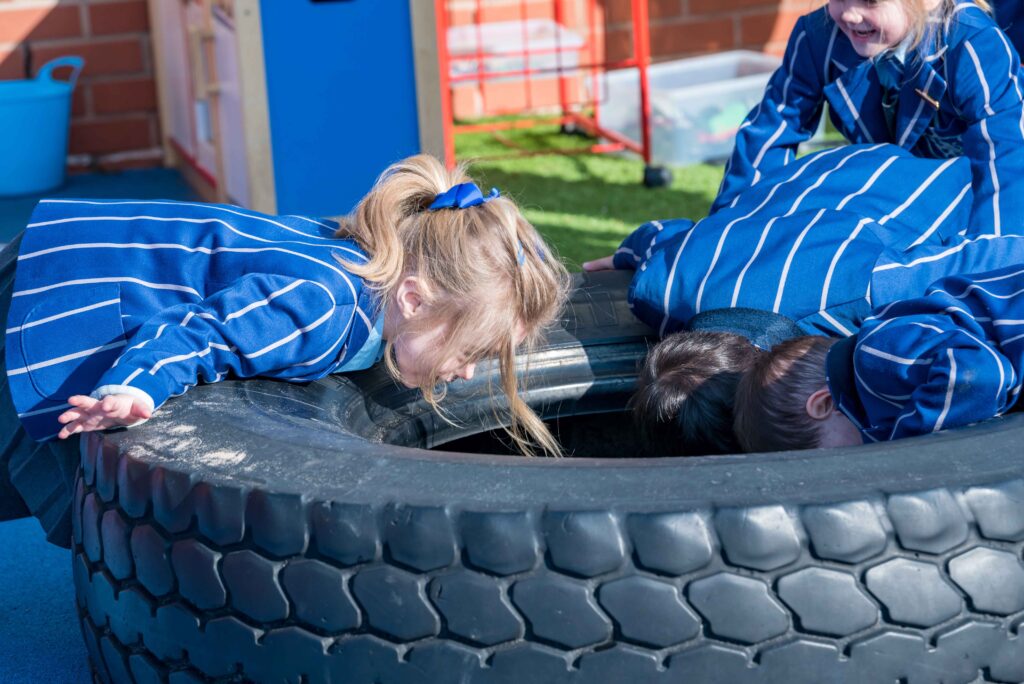
Gross Motor Skills: Children demonstrate strength, balance and coordination when playing, and showcase a range of ways to move energetically through activities such as running, jumping, dancing, hopping, skipping and climbing. They learn to navigate space and obstacles safely, with consideration for themselves and others. Our EYFS department benefits from specialist PE teaching, regular visits to our Forest School led by a qualified Forest School Coordinator, and trips to nearby Worsley Woods.
Fine Motor Skills: Fine motor skills require whole-body strength and stability which is why so much specialist provision underpins this development. Children are supported to demonstrate their ability to use various handheld tools, such as scissors, use a secure and effective grip (usually a tripod grip), and to manipulate a mark-making tool with control, care and accuracy.
3. Personal, Social and Emotional Development
This area includes three strands:
Self-Regulation: Children learn to identify their own and others’ emotions and begin to regulate their behaviour and impulses. They develop the ability to follow instructions, set goals and work towards them.
Managing Self: Children gain independence in managing personal hygiene and basic needs. They demonstrate perseverance and resilience in tackling challenges and understand the importance of rules.
Building Relationships: Through cooperative play, turn-taking and understanding others’ perspectives, children are supported to build strong, positive relationships.
The Seven Areas of Learning – Specific areas
The four Specific areas help children build upon the foundations set by the Prime areas.
1. Literacy
This area includes ‘Comprehension’, ‘Word Reading’ and ‘Writing’.
Children demonstrate their understanding through opportunities to retell stories using small world, role-play and discussions. They are encouraged to mark-make in various ways, learn letter names and sounds (phenomes), and progress to reading and writing digraphs, trigraphs, phrases, and sentences.
2. Mathematics
This area includes ‘Number’ and ‘Numerical Patterns’.
Children learn to solve mathematical problems through exploration and practical activities. Subitising forms the basis for mental maths skill development. Families receive support through short videos on Google Classroom to help them understand how their child is being taught and how they can provide support at home. ‘Master the Curriculum’ in EYFS ensures a smooth transition from Reception to Prep I, where pupils begin ‘White Rose Maths’.
3. Understanding the World
This area includes ‘Past and Present’, ‘People, Culture and Communities’ and ‘The Natural World’.
Children bring their own experiences and knowledge to the setting, which are then explored, built upon and extended through planned classroom activities. These experiences are further enhanced through ICT, reference books, and other resources. Our Forest School is an integral tool to deepen pupils’ understanding of the natural world.
4. Expressive Arts and Design
This area includes ‘Creating with Materials’ and ‘Being Imaginative and Expressive’.
Children are encouraged to explore their creativity freely, developing skills that will support them throughout their lives.
All Areas of Learning and Characteristics of Effective Learning are interconnected, ensuring a well-rounded foundation for each child’s progress.